

Title:
LG’s Strategic Pivot to Embodied AI: A Deep Dive into the NVIDIA Partnership and the Future of Robotics
Keywords:
LG Group, NVIDIA, Embodied AI, Robotics, Collaborative Intelligence, Edge Computing, Autonomous Systems, Market Dynamics
Introduction: A New Alliance at the Frontier of AI
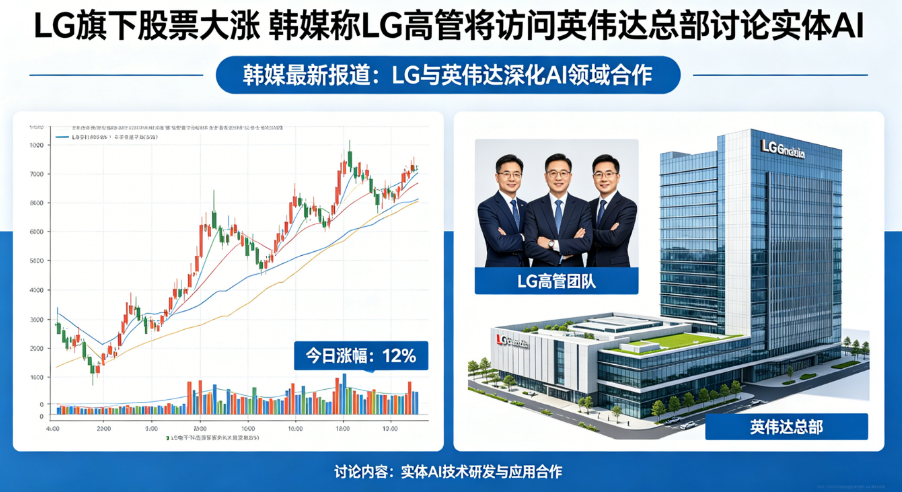
On a crisp Monday morning, a delegation of top executives from LG Group’s core subsidiaries—LG Electronics, LG CNS, and LG Innotek—arrived at the Santa Clara headquarters of NVIDIA. Their mission: to forge a comprehensive partnership in the rapidly evolving domains of embodied artificial intelligence (AI) and robotics. This visit, reported by South Korea’s Asia Business Daily, comes on the heels of a high-profile meeting earlier this month between LG Group Chairman Koo Kwang-mo and NVIDIA CEO Jensen Huang in Seoul. The market’s immediate reaction was telling: LG Electronics shares surged 12% in Seoul trading, LG CNS jumped 14%, and LG Corp. rose 7%.
But behind these numbers lies a deeper story—one that reflects a tectonic shift in the global AI landscape. Embodied AI, the integration of artificial intelligence with physical systems capable of sensing, reasoning, and acting in the real world, is no longer a distant promise. It is the next front in the battle for industrial and consumer dominance. LG’s move to align with NVIDIA, the undisputed leader in AI hardware and software infrastructure, signals a deliberate strategy to leapfrog competitors in robotics, smart manufacturing, and autonomous systems.
This article unpacks the technical, strategic, and market implications of the LG-NVIDIA collaboration, exploring how embodied AI is poised to reshape industries and why LG’s timing is both ambitious and necessary.
The Rise of Embodied AI: Beyond the Chatbot
To understand the significance of this partnership, we must first define what embodied AI truly entails. Unlike generative AI models that operate in the digital realm—producing text, images, or code—embodied AI requires machines to perceive their environment, reason about physical constraints, and execute actions with precision and safety. This includes autonomous mobile robots (AMRs), collaborative robotic arms (cobots), humanoid platforms, and even autonomous vehicles.
The technical challenges are immense. Embodied systems demand real-time sensor fusion, low-latency inference, and robust decision-making under uncertainty. Traditional AI models, often deployed on cloud servers, are ill-suited for the latency and bandwidth constraints of physical interaction. This is where NVIDIA’s platform shines: the Jetson family of edge AI modules, the Isaac robotics software stack, and the Omniverse simulation platform provide a complete pipeline for developing, simulating, and deploying embodied AI at scale.
LG’s subsidiaries bring complementary expertise. LG Electronics has long been a leader in home appliances and consumer electronics, with a growing portfolio of service robots (like the CLOi series) and smart factory solutions. LG CNS specializes in IT services, cloud computing, and digital transformation—critical for integrating AI into enterprise operations. LG Innotek manufactures advanced components, including camera modules, sensors, and printed circuit boards, which are essential for perception and actuation in robotic systems. Together, they form a vertically integrated capability that, when combined with NVIDIA’s core AI technologies, could produce breakthrough products in logistics, healthcare, hospitality, and beyond.
Technical Synergies: From Silicon to Simulation
At the heart of any embodied AI system lies the compute platform. NVIDIA’s recent announcements—the Blackwell GPU architecture, the Grace Hopper superchip, and the dedicated robotics platform “Project GR00T” (Generalist Robot 001)—represent a generational leap in performance per watt. For LG, adopting these technologies means being able to run complex neural networks for object detection, path planning, and manipulation directly on the robot, without relying on a constant cloud connection.
Consider a warehouse robot tasked with sorting parcels. It must identify items by shape, weight, and labeling; plan an efficient grasp; navigate around obstacles; and coordinate with other robots—all within milliseconds. This requires a combination of convolutional neural networks (CNNs) for vision, transformers for scene understanding, and reinforcement learning for adaptive behavior. NVIDIA’s TensorRT and cuDNN libraries accelerate these models on Jetson modules, while Isaac Sim allows LG engineers to train and test policies in photorealistic virtual environments before deployment. Such simulation-to-reality (sim2real) transfer drastically reduces development time and cost.
Moreover, LG CNS can leverage NVIDIA’s AI Enterprise software suite to orchestrate large-scale training jobs on its cloud infrastructure, fine-tuning models on proprietary data from LG’s factories and retail operations. This creates a virtuous loop: real-world data improves simulation models, which in turn generate more robust policies for deployment.
Strategic Dimensions: Why Now and Why Together?
The timing of this partnership is no accident. The global robotics market is projected to grow from approximately $58 billion in 2024 to over $200 billion by 2030, according to market research. Within that, service robots—the segment most relevant to LG’s consumer and commercial businesses—are expected to see the fastest growth. Yet competition is fierce: Boston Dynamics, Tesla (with Optimus), Amazon (with Proteus and Sparrow), and a host of Chinese startups are all racing to commercialize humanoid and specialized robots.
For LG, which has historically been cautious in robotics compared to its Korean rival Samsung (which acquired Harman and built its own AI platform), this partnership signals a clear pivot. By tying its fortunes to NVIDIA, LG gains immediate access to the world’s most advanced AI hardware and software ecosystem, bypassing years of internal R&D. NVIDIA, meanwhile, benefits from LG’s manufacturing scale, global distribution networks, and deep domain knowledge in home appliances and industrial automation. It is a classic “platform + application” strategy: NVIDIA provides the AI plumbing (chips, SDKs, simulation tools), and LG builds the end-user solutions.
From a Korean national perspective, this collaboration also strengthens the country’s position in the advanced semiconductor and AI supply chains. Seoul has been pushing for greater self-sufficiency in AI infrastructure, and LG’s alignment with a non-Chinese, US-based partner like NVIDIA could serve as a hedge against geopolitical uncertainties.
Market Implications and the Stock Surge
The immediate stock market reaction—LG Electronics up 12%, LG CNS up 14%, LG Corp. up 7%—reflects investor optimism about the potential revenue streams from embodied AI. But analysts caution that the path to profitability is long. Robotics hardware is notoriously capital-intensive, and the unit economics of service robots remain challenging. For instance, LG’s CLOi robots have been deployed in airports, hotels, and museums, but volume has been modest. A deeper partnership with NVIDIA could lower costs through economies of scale in compute modules and accelerate software development, but it will take years to see material financial impact.
Nevertheless, the stock moves also indicate a re-rating of LG’s technology profile. Historically viewed as a conglomerate with mature electronics and chemical businesses, LG is now being recognized as a potential leader in the next wave of AI-driven automation. The fact that Chairman Koo personally met with Jensen Huang—a rarity for executives outside the hyperscale data center space—underscores the strategic importance placed on this alliance.
Conclusion: A Calculated Bet on the Physical-Digital Continuum
The LG-NVIDIA partnership is a quintessential example of how incumbents in traditional industries are leveraging platform leaders to enter emerging technology markets. Embodied AI represents the convergence of the digital and physical worlds—a domain where software intelligence must interface with hardware constraints. LG’s expertise in manufacturing, integrated circuits, and consumer interfaces, combined with NVIDIA’s foundation in AI compute and simulation, creates a powerful vector for innovation.
However, success is not guaranteed. The collaboration must overcome technical hurdles in real-world reliability, safety certification, and cost reduction. Moreover, competition from dedicated robotics firms and tech giants with deeper pockets will be relentless. Yet, for LG, the alternative—staying on the sidelines—is far riskier. As Jensen Huang himself has often said, “The future of robotics is not just about moving boxes; it’s about creating a new species of intelligent machines.” With this partnership, LG is taking a deliberate step toward shaping that future. The market’s applause is justified, but the real work has only just begun.
(Word count: approximately 1,500)
Copyright Notice: This article is original content of Dhaka Bullion. Please contact us for republication permission.

